
Imagine lying awake at 2 AM. Your mind is racing with a fear so overwhelming you can literally feel the physical weight of panic in your chest.
When you are in the middle of a catastrophic spiral, well-meaning platitudes like "just have more faith" or "God is on His throne" often do more harm than good. While theologically true, these statements can inadvertently induce guilt, making you feel as though your fear is a spiritual failure or a sign that you don't trust God enough.
What you actually need in those turbulent moments are practical, effective grounding techniques that anchor your nervous system back to reality without dismissing your emotional pain.
A Practical Two-Step Thought Experiment
A highly effective thought experiment designed not to instantly eliminate your distress, but to logically contain it.
Here are specific, actionable grounding techniques you can apply when panic sets in:
Step 1: Explicitly Name the Fear on Paper
When we panic, the fear is often a vague, swirling cloud of emotional and somatic turmoil. Force yourself to slow down and write the exact worst-case scenario down on paper. This simple act of writing provides a logical counter-voice against your subconscious habit of instantly inflating a minor risk into a massive, 10-out-of-10 threat.
Step 2: Mathematically Quantify the Probability
Look logically at your past history. If your fear is losing your job, ask yourself how many times that has actually happened in your career. Quantifying the mathematical probability helps contain the intense psychological distress.
Step 3: Contain Rather Than Suppress
The goal of this exercise isn't to pretend the fear doesn't exist, but to put it in a confined, logical box. You still might not know what tomorrow holds, but you can view it logically rather than being consumed by it.
Step 4: Use Your Faith as an Anchor
Acknowledge your emotional fear while simultaneously trusting God through the distress. Remember that Christ paired the phrase "little faith" with affectionate terms, acting as a comforting presence rather than a disappointed judge.
Integrating Faith Without Invalidating Pain
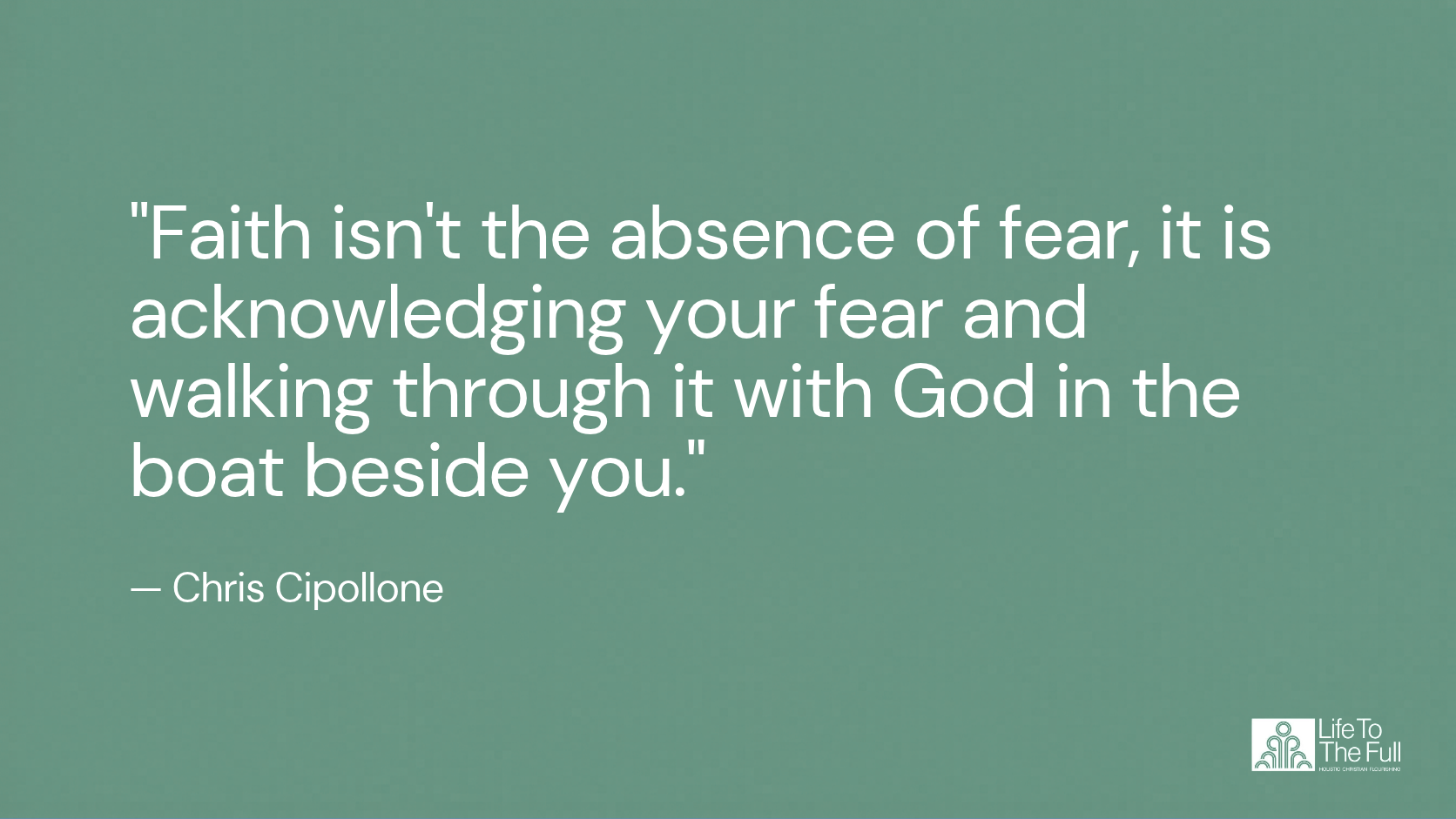
Alongside these clinical grounding steps, there is immense comfort in how we integrate our spirituality. True faith does not mean the absolute absence of fear.
Instead, faith involves acknowledging our very real fears and choosing to walk through them with God present by our side.
Think of the biblical account of the storm: Jesus was not standing safely on the shore shouting instructions at the disciples; He was in the boat with them while the wind and waves raged. Knowing He is in the boat with you allows you to hit the fear head-on, trusting that you are held securely even when the storm hasn't calmed yet.
When to Seek Professional Intervention
Sometimes, the anxiety is simply too heavy to manage with personal coping mechanisms. The primary litmus test for seeking professional help is evaluating what the catastrophizing is costing you in terms of your daily functioning and personal flourishing.
Rather than over-analyzing whether your pain is "bad enough," it is often best to consult a medical professional and utilize evidence-based screening questionnaires to let them quantify your level of distress for you.
Seeking Guidance for the Storm
If you are struggling to manage overwhelming fear and find that your daily flourishing is severely impacted, it may be time to seek a higher level of care. Our team at Life To The Full uniquely integrates evidence-based clinical practices with deep spiritual direction.
Through our diverse team of counsellors, psychologists, and spiritual directors, we offer both in-person and online support to help you navigate life's storms with grounding, grace, and professional guidance.