
How to Deal With Guilt & Shame: Moving from Shame to Freedom

For many of us, guilt and shame are constant companions. They can feel like a heavy weight you carry everywhere you go, an exhausting, paralyzing burden that you just can't seem to put down.
If you find yourself searching for answers, wondering "Why do I feel so much shame?" or "How do I let go of this guilt?", please know that you are not alone. These are some of the most common and silent struggles people face. But there is a way through.
To find freedom, we first need to understand what we are actually feeling, because guilt and shame are not.
The Core Distinction: Guilt vs. Shame
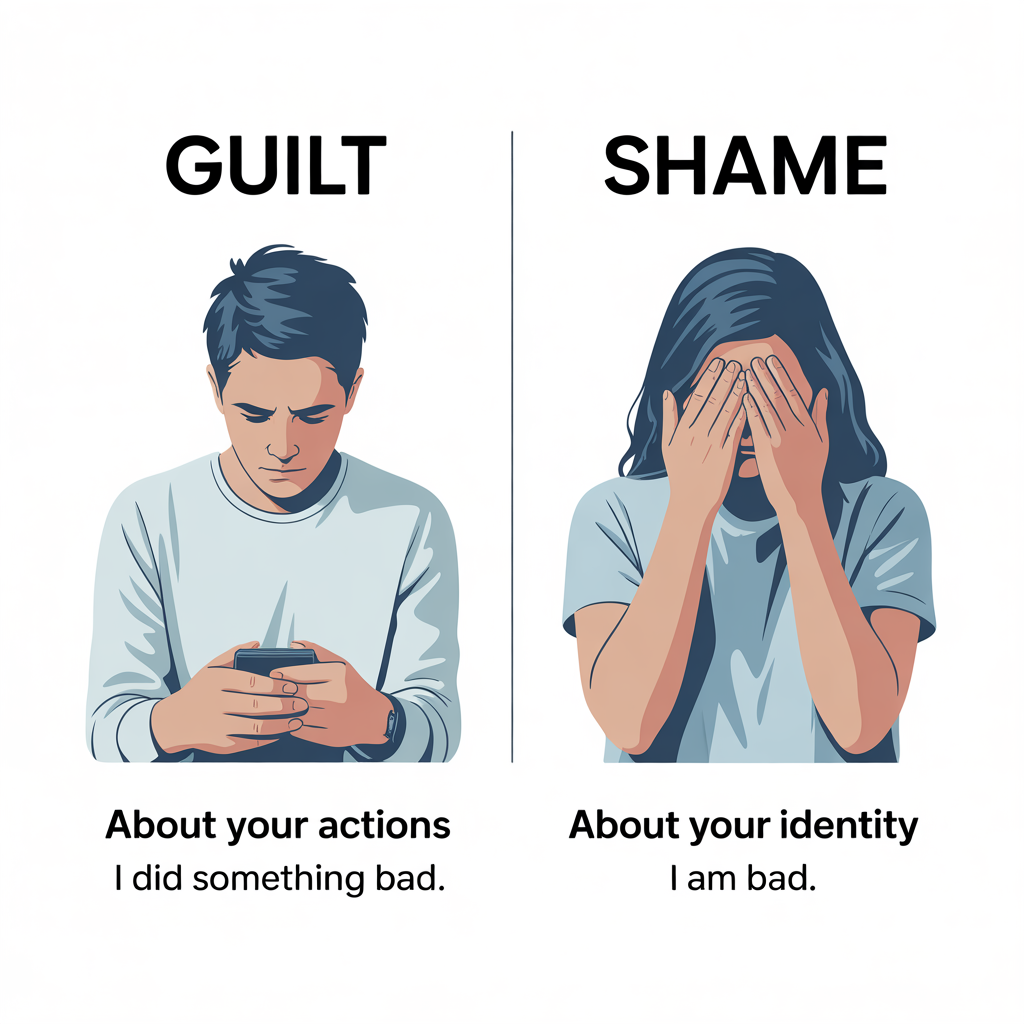
In our everyday language, we often use these words interchangeably, but they are fundamentally different experiences.
Guilt is about your actions. It says, "I did something bad." It is an external verdict on behavior that didn't meet a standard.
Shame is about your identity. It says, "I am bad." It is an internal feeling of being fundamentally flawed or unworthy.
Think of it this way: Guilt is like seeing a stain on your favorite shirt. It means you made a mess, and it needs to be cleaned or repaired. The shirt is still valuable, but the action caused a problem.
Shame is believing the entire shirt is garbage. It attacks the worth of the object itself, leaving you feeling unfit to be seen or worn, regardless of whether the stain is cleaned.
This distinction is critical. You can fix a mistake (guilt), but it's much harder to fix a "flawed self" (shame). When we confuse the two, we get stuck believing that we are the problem, rather than dealing with what we did.
Where Does Toxic Shame Come From?
If shame is so damaging, why is it so common? Its roots often go deep.
Personality: Some of us are naturally more "sensitive souls," biologically wired to feel emotions more deeply.
Family of Origin: Many of us grew up in environments where healthy discipline was missing. Instead of being told, "That behavior wasn't okay," we might have heard, "You will never amount to anything." When we don't experience healthy shame, which is discipline with dignity, we internalize toxic shame.
The Digital Age: Our modern world can amplify shame. Online interactions often lack empathy, creating a culture where people are quickly "cancelled" or cast onto "Shame Island" with no path back. This fear of permanent rejection fuels our internal shame.
A Christian Perspective: Grace as the Antidote

From a faith perspective, we have to be very careful when dealing with this concept. Many will say there is no place for shame. But we do have to wrestle with the fact that scripture seems to hold out some concept of upholding a healthy place for shame:
Do not be misled: “Bad company corrupts good character.”Come back to your senses as you ought, and stop sinning; for there are some who are ignorant of God—I say this to your shame.
1 Corinthians 15:33-34
Some of the tension we feel when we read a verse like this is semantic. Perhaps the problem is that we have different views in our mind of what we mean when we’re talking about guilt and shame.
But whatever word we use, the Bible upholds that there is an important developmental function in recognising that we are on the wrong path, and that sometimes, the struggles we’re facing in our lives can be partly as a result of our own wrongdoing. An example of this would be in relationships. Perhaps we have had a falling out with a loved one because we ourselves have contributed to the problem through our own folly.
By our modern definition, perhaps Paul is talking about feeling guilty rather than shame. But the word we use becomes secondary to the main point being made here. That is, acknowledging our wrongdoing and responding with humility is a crucial part of our growth as imperfect people. In this way, we might say that there is such a thing as "healthy shame," or depending on how we use the word, “having a right sense of guilt”, that acknowledges we have fallen short of God's glory. However we understand the words we’re using, the key to understanding it all is that we should never be left in a place of self-condemnation, especially when we are committed to the path of humility. Rather, we should be focused on a path that points us toward redemption.
This is the unique power of the Christian message of grace. We don't have to hide our guilt or shame, because we have a solution. We can acknowledge our mistakes because they have already been paid for.
Ultimately, the antidote to shame is a secure identity. The Bible tells us in 1 John 3:1 to "See what great love the Father has lavished on us, that we should be called children of God!"
A loving father may discipline his child, but he never condemns them. Your identity as a beloved child of God is secure. It is an anchor that holds firm, regardless of your mistakes. You are worthy of love and belonging, not because of what you do, but because of who you are in Him.
Practical Steps: How to Start Letting Go
Knowing this truth is one thing; living it is another. How do you practically start to let go of the weight you're carrying?
1. Step Into the Shame (The Counter-Intuitive First Step)
Our instinct is to run from shame, to hide it. But Chris Cipollone, our Founding Director, suggests the opposite. To process shame, you have to acknowledge it. You have to name it to tame it. Don't ignore the feeling; bring it into the light.
2. Externalize It
Shame grows in the dark, but it dissipates in the light. Talk to someone, whether that is a counsellor, a pastor, or a trusted friend. We often assume everything is 100% our fault. An outside perspective can help you separate what is truly your responsibility from what isn't, helping you see the situation clearly.
3. Extend Kindness to Yourself
Try the "friend test." If a close friend came to you with the exact struggle you are facing, how would you treat them? You would likely offer compassion and grace. Why do you deserve less? Practice extending that same kindness to yourself.
4. Reframe the Future
Unresolved shame from the past often fuels anxiety about the future, creating that sense of "impending doom." We fear that our past mistakes will inevitably ruin our future. But by healing the past through grace, you build a foundation of hope for the future. You learn that your story is a redemptive one, where even your mistakes can be woven into a larger plan of growth and restoration.
Conclusion: You Are More Than Your Mistakes
Feeling guilty doesn't mean you are guilty in your identity. Feeling shame doesn't mean you are shameful. These are feelings, not final verdicts.
Don't give up on the process. It can be difficult to bring these dark feelings into the light, but it is profoundly liberating. You are more than your mistakes. You are a beloved child, worthy of love, forgiveness, and a future free from the heavy burden of shame.