
What are Major Life Transitions & How to Cope With It
If you are reading this, chances are you are in motion. Perhaps you’ve just packed up a home you lived in for twenty years, signed career change papers, or noticed the house is deafeningly quiet after the last child left for uni.
We assume that if a change is positive, like a hard-earned retirement or kids successfully launching, we should feel nothing but happiness. Yet, research shows a massive surge in searches for "empty nest syndrome" and "career anxiety." Many of us feel a strange sense of grief when we should be celebrating.
Why do these milestones, even the ones we planned for, seem to feel so destabilising?
The Hidden Cause: Change vs. Transition
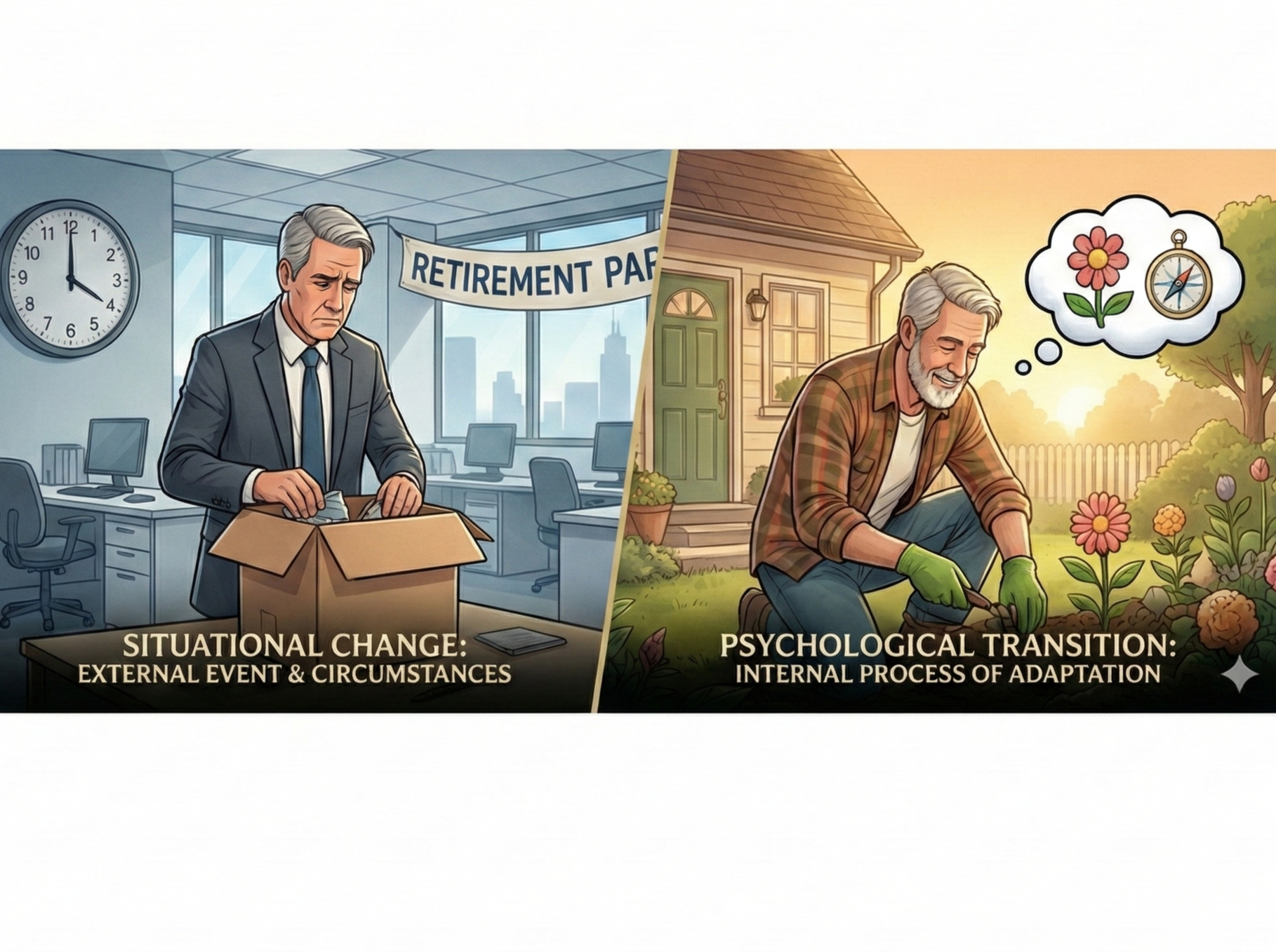
The confusion lies in the difference between the event and the experience. We use the words interchangeably, but they are miles apart.
Change is Situational: It is the event. It’s the removalist truck, the farewell party, or the resignation letter. Change happens to you, and it happens quickly.
Transition is Psychological: It is the internal, slow, and messy process of reorientation you must go through to catch up.
When a major role like "CEO" or "Full-time Mum" is removed, it creates a vacuum. You wake up on a Monday morning with nowhere to be. You feel rudderless, not because the change is bad, but because the structure is gone.
We suffer because we try to rush the transition. We expect our hearts to catch up to our circumstances instantly. But according to the Bridges Transition Model, you cannot jump straight from an "Ending" to a "New Beginning." You must first pass through the "Neutral Zone."
This Neutral Zone feels like fog. It feels unproductive. It’s the trapeze artist floating in mid-air after letting go of one bar but before catching the next. It’s terrifying, but if you try to skip it, you drag the baggage of your old life into your new one.
The Trap Keeping You Stuck

Why does this vacuum hurt so much? Because of the "Meritocracy Trap."
We live in a culture that judges us by our output. When your value is tied to your utility, for example, how much money you make, or how busy you are then you are operating on Earned Worth.
This is fragile. The moment the role fades (e.g., redundancy or retirement), your output drops to zero, and your internal narrator says: I am not good enough.
The Antidote: Intrinsic Worth The Christian faith offers a secure anchor that the meritocracy cannot touch:
Worth is Received, Not Achieved: You are not ultimately what you do. Value is inherent, not earned.
Identity is Fixed: Your status as a "beloved child of God" holds through the turbulence because it isn't conditional on your performance review.
3 Mindset Shifts for Navigating Major Life Transitions
Once we anchor our identity, we can look at our changing circumstances with fresh eyes. Here are three mental shifts to help you find your footing:
1. For Retirement: The "Dial" vs. The "Switch"
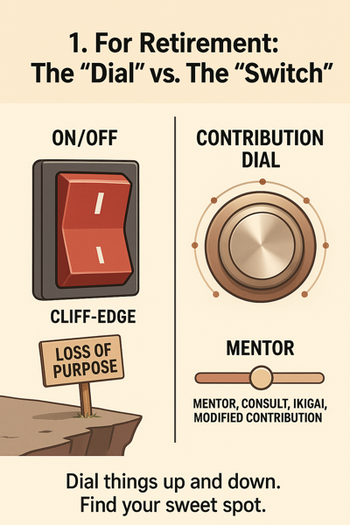
Stop viewing work and retirement as a switch (ON vs. OFF). This "cliff-edge" approach leads to a sudden loss of purpose.
The Shift: Adopt the metaphor of a dial. We are made for contribution. The goal is to "dial things up and down" depending on your life stage. Align with the Japanese concept of Ikigai (Purpose)—finding the sweet spot between what you love, what you are good at, and what the world needs. Don't just "collect sea shells"; find your modified contribution. Can you mentor? Consult? Keep the engine running, just at a different speed.
2. For Ageing: The "Third Quarter"
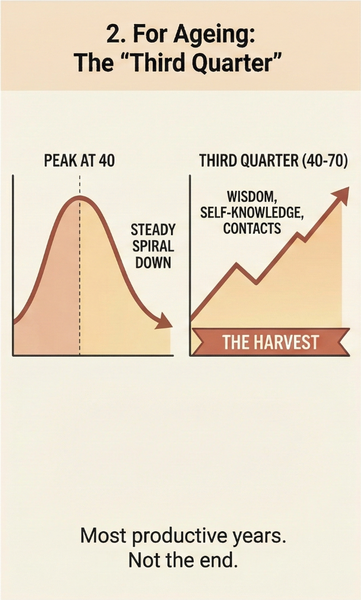
There is a fear that life is a bell curve: you peak at 40, and it is a "steady spiral down" from there.
The Shift: Challenge the narrative. The years between 40 and 70 i.e. the "Third Quarter", can be the most productive years of your life. You now possess a trifecta you didn't have in your 20s: wisdom, self-knowledge, and contacts. This isn't the end; it's the harvest.
3. For Parents: From "Manager" to "Consultant"
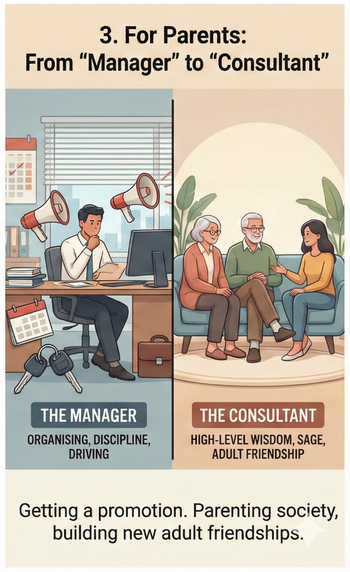
For empty nesters, the grief is real. But practically, you aren't just losing a job; you are getting a promotion.
The Shift: Change your title.
The Manager: This was your old role, namely, organising schedules, enforcing discipline, and driving the car.
The Consultant: This is your new role. A consultant isn't in the weeds; they are available for high-level wisdom when asked. This shift frees you up to find purpose in "parenting the society around you" and taking on the role of the sage in your community, while building a new, adult friendship with your children.
3 Ways To Cope With Life Transitions

If you are currently in the fog, here are three actionable tools derived from our psychological work at Life to the Full.
1. Step into the Present (The ACT Approach)
Anxiety lives in the future ("What happens next?"); grief lives in the past ("I wish I was back there"). Peace is uniquely found in the present.
The Practice: Use sensory grounding to pull your focus out of your head.
Try This: Stop. Take a breath. Ask yourself: "What can I see right now? What can I smell? What can I hear?"
The Result: This simple friction breaks the spiral of worry and reorients the brain to the "here and now."
2. Process the "Opportunity Cost"
Every gain requires a loss. You cannot embrace the empty nest without grieving the full house.
The Practice: Consciously "pay the emotional cost." Reflect on what was "good and hard" about the previous season. Write it down. Say goodbye to it.
The Result: Recognising that life is a series of trade-offs helps you "translate" your old life into the new one without resentment.
3. Ground Your Purpose
Roles change, but your "True North" shouldn't.
The Practice: Ensure your purpose is transferable. If your purpose is "to be a CEO," you will eventually fail. If your purpose is "to love God and love your neighbour," you can do that as a retiree, an empty nester, or even in a hospital bed.
Trusting God Through Redirection
Finally, we must ground this process in trust.
We are limited to hindsight; we can only see where we have been. God has foresight. As Chris reminds us, "We may not always trace God's hand, but we can always trust God's heart."
In a secular worldview, ageing looks like a gradual disintegration. The Christian story flips this. A transition is not a rejection; it is a redirection. We are not moving toward the end, but one step closer to the renewal of all things.
If you are in the hallway right now, don't rush the door. The confusion of the transition is often the breeding ground for your deepest spiritual formation.
Embrace Your Next Chapter with Confidence Today
If you are ready to move from the confusion of the "Neutral Zone" towards renewed purpose, identity, and direction, our compassionate team at Life to the Full is here to walk alongside you.