
Why Questioning Your Faith Can Actually Make It Stronger

Ever typed "Help my unbelief" into a search bar? Let's be real for a second. It's a vulnerable place to be. You're wrestling with doubts, maybe feeling distant from the church, from God, from everything you thought you knew. And there's this isolating feeling that you're the only one going through it.
I get it. I really do. I've been there in my own way.
If you're wrestling with those hard questions, that tells me you care. It means you're still in the fight. It's when we stop caring, when we become indifferent, that's when we're in trouble.
So, what do we do with these doubts? Do we shove them down, pretend they don't exist? I don't think so. If Jesus is the way, the truth, and the life, then we should be able to bring our assumptions to the table. We should be able to put him to the test.
That's what I want to explore with you. How do we navigate those tough questions without losing ourselves? How do we create a safe space for doubt, a place where we can be honest about our struggles and still find hope?
1. Doubt vs. Apathy: Why Caring Matters
My mentor once told me something profound: Doubt is not the opposite of faith. Apathy is the opposite of faith.
If you're wrestling with doubts, that might actually be a good sign. When you are doubting, you care. The fact that you care shows that you're on a good journey. The bigger warning sign in faith is when people don't care anymore. That, in my understanding, would be the opposite of faith.
Think of it this way. Apathy is like a marriage where no one argues anymore. The silence isn't peace; it's indifference. Doubt, on the other hand, is like a couple arguing about how to raise their kids. It's messy, but it shows they're invested.
Does that resonate with you?
Here's the thing we often miss: Doubt isn't a dead end. It's an invitation. An invitation to dig deeper, to question assumptions, to wrestle with what you believe and why. It's about owning your faith, not just inheriting it.
So, if you're feeling those pangs of doubt, don't panic. Don't feel guilty. Instead, ask yourself: What am I really wrestling with? What assumptions am I holding onto? What questions am I afraid to ask?
2. Putting Jesus to the Test: Why Doubt Can Lead to Deeper Faith
When you're wrestling with doubts, it actually shows you care. At Life to the Full, we see doubt as a signpost on the journey.
Here's the thing: my role as a spiritual director isn't to squash your doubts. It's to help you doubt well. It might sound odd, but I believe it wholeheartedly.
You should be able to put all your assumptions on the table. If Jesus truly holds the truth, those doubts will lead you to an even deeper faith.
We often get defensive in faith conversations. "Don't ask the hard questions!" people say. But I say, actually, you can and you should. If this is God's world, and Jesus claims to be the son of God, then put him to the test. See what He has to say. I'd argue that, through His Word and by His Spirit, those truths will come out if you go through that process well.
At Life to the Full, we aim to create a safe, non-judgmental space. A space where people can admit their doubts out loud. The truth is, the church isn't always great at this. But it needs to be.
3. Doubt vs. Unbelief: Core Beliefs and the Person of Jesus
What separates doubt from unbelief? It's a question I get asked all the time here at Life to the Full.
Christianity is a funny thing. It's incredibly simple. Jesus is the way, the truth, and the life. He says, "Let the little children come to me, for the kingdom belongs to such as these." Yet, there's a lifetime of exploration. Depths we can plum that we'll never graduate from this side of heaven.
So, when do you go from doubt to unbelief? Unbelief sits in the territory of the core claims of Christianity. Do you believe in a God in heaven? Do you believe that Jesus was the saviour of the world? And that he rose from the dead?
I think of Romans 10:9. It says that if we confess with our mouths that Jesus is Lord and God raised him from the dead, then we will be saved.
So, if a client is wrestling with doubt, I'll ask: Do you agree or disagree with those core truths about the person and the work of Jesus Christ?
When you break it down like that, people often say, "Oh no, no, I still believe that." They're actually doubting or working through the implications. What does it mean if Jesus rose from the dead? How does that impact my life today?
What people think are doubts toward God can actually be hurts caused by the church. People struggle to differentiate between their experience of imperfect people and the claims of a perfect God.
Someone might have had a terrible experience with a pastor. Maybe they were judged or excluded by a church community. It's understandable that they might start questioning everything.
But is their doubt really about God? Or is it about the actions of flawed human beings?
I find that, for the most part, what people worry about as unbelief is actually a healthy doubt. It's a sign they care. And caring means you're on a journey, not a dead end.
So, I encourage you to ask yourself: What's the question behind the question? Are you truly rejecting the core claims of Christianity? Or are you wrestling with the implications?
Practical Steps for Navigating Doubt
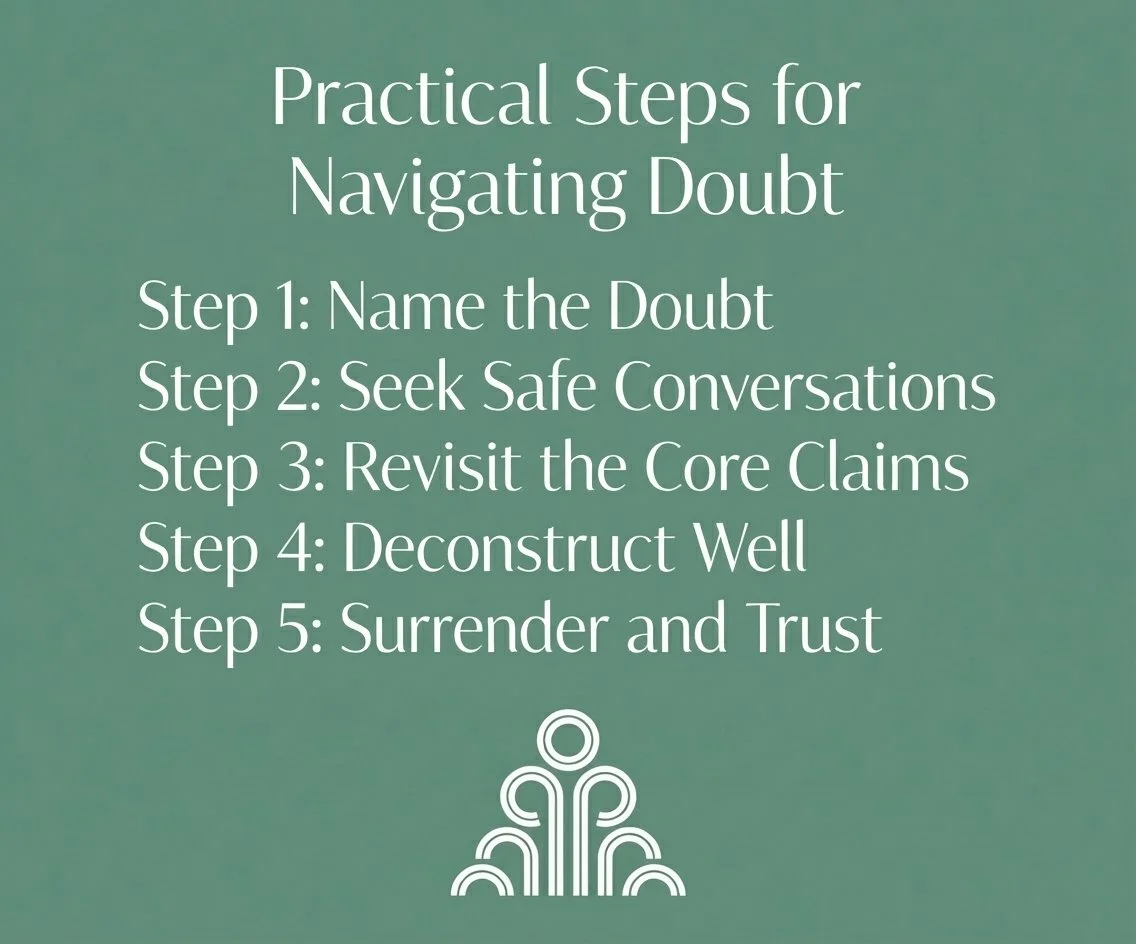
If you're wrestling with doubt, that means you care. That means you're still in the game. So, how do you navigate those doubts without losing your footing? Here are a few practical steps that I have found helpful.
Step 1: Name the Doubt
Get specific. What exactly are you questioning? Often, we get tangled in vague anxieties. What is the actual issue? What assumption are you putting on the table?
Are you doubting God, or are you actually hurting because of something that happened at church? Is it a theological point or is it an emotional wound?
I find that people struggle to differentiate between their experience of imperfect people and the claims of a perfect God. And so, often the problem is not actually unbelief, but a healthy doubt.
Step 2: Seek Safe Conversations
You can't do this alone. Find a trusted friend, a mentor, or even a spiritual director—someone who will listen without judgment. Someone who can help nurture you through it. Look, the work I do is quite specific, and it's fairly new in an Australian context particularly, but is there a spiritual director you can seek out who can just listen and hear?
If you don't have access to that, whether that be financially or geographically, find one or two good friends that just, you know, will have your back, who won't necessarily tell you what you want to hear, but they know that, uh, they will love you.
Have you tried to do the conflict well? And if you have and it hasn't gone well, recognise that other people's flaws do not negate the faithfulness and the perfection of God.
Step 3: Revisit the Core Claims
When does doubt become unbelief? Unbelief begins when we start to reject the core claims of Christianity. Do you believe in a God in heaven? Do you believe that Jesus was the saviour of the world and he rose from the dead?
Romans 10:9 says that if we confess with our mouths that Jesus is Lord and God raised him from the dead, then we will be saved. So, when a client is wrestling with doubt, I ask them, "Do you agree or disagree with those core truths around the person and the work of Jesus Christ?"
Often, people will say, "Oh, no, no, I still believe that." What they're actually doing is doubting or working through the implications.
Step 4: Deconstruct Well
I have a friend that talks about how he very willingly helps people deconstruct to the point of being at the feet of Jesus. Does that resonate with you? Deconstructing the hurts, challenging the institution—that can be good. But if we deconstruct past the person of Christ, then we're in spiritual trouble.
I think actually breaking things down, challenging assumptions, asking questions, bringing up doubts is a very very healthy thing. But again, can you do it in a safe environment where somebody can help nurture you through it?
One of the litmus tests is: Can you deconstruct in a way that still upholds the goodness of Christ and the sanctity of his Word? Can you cry out to God and lament and express your hurts and your questions, while also keeping him on his throne as Lord? If deconstruction gets us past Jesus Christ as Lord, then we've deconstructed too far.
Step 5: Surrender and Trust
Behind surrender is trust. You can only surrender to one whom you trust. And this is why the cross is so vital. The cross is the demonstration that God is for you and not against you.
Whatever he is doing in your life, and wherever your hurts and your doubts lie, can you let that be the lens by which you view your present circumstances? Is the God who sent his Son on Calvary the same God who is over your life?
God has always said, "No, can you just trust me with your finite amount of insight to do what I need to do?" That's what surrender is.