
How Do I Stop Overthinking?

It is 1:00 AM, you are lying in bed, and your mind is locked onto a conversation you had three days ago. Or maybe you are standing on the side-lines at your child’s soccer game, but mentally, you are miles away, endlessly cycling through a worst-case scenario.
If you are constantly exhausted by your own mind, you are not alone. Overthinking is a universal pain point that drains our physical and emotional capacity for everyday life. But finding relief requires more than just telling yourself to "stop worrying".
Right now, thousands of people globally are searching for ways to stop this relentless mental loop. To help you find real relief, we need to look beyond the buzzwords and explore both clinical frameworks and spiritual truths that can help you regain your peace.
The Tipping Point: Are You Planning or Overthinking?
We often try to justify our racing thoughts by calling it "preparation." After all, thinking and planning are natural parts of how God designed our brains. But there is a distinct boundary where healthy preparation curdles into destructive overthinking.
Clinically, you can identify this shift by asking yourself two questions:
Are these thoughts intrusive? The line is crossed when thoughts become entirely unwelcome and you find yourself completely unable to switch them off.
Are you "fused" to your thoughts? This psychological term describes the feeling of being glued to your worries, engaging in them far more often than you actually want to.
When you lose the ability to disengage, your thoughts stop serving you and start controlling you. This loss of control often leads us straight into a mental trap known as rumination.
The Trap of Rumination: Why "Fixing It" Isn't Working
We usually treat overthinking as a simple "brain problem," but it is deeply tied to clinical anxiety. When we feel anxious, we deploy a defence mechanism called rumination.
Rumination is the false belief that you are problem-solving your way to a solution, when in reality, you are only dragging yourself deeper and deeper into the weeds. You scan every variable, convinced that if you just strategize long enough, you can control the outcome and alleviate your fears.
The Cost of the Perfect Scenario: A Personal Reflection
I experienced this trap first-hand years ago while facing a major job decision that required my family to relocate. I’ve always been pretty good with an Excel spreadsheet and setting a budget, so I decided to map out the financial implications to find clarity.
At first, it felt like effective problem-solving. But then I began tweaking tiny variables—comparing a three-bedroom house to a four-bedroom house, and factoring in what it would look like if my wife picked up a two-day-a-week job. What started as a logical, helpful process slowly spiraled into a manic exploration for the "perfect" scenario.
I remember looking at my laptop desktop at the time; there were about 40 different versions of that spreadsheet. I was convinced that if I could just iterate the variables one more time, I would find the peace I was looking for. Ironically, I had gotten so deep into the data and the "what-ifs" that I had completely forgotten what the job itself was actually about. I felt zero peace, and ultimately, I turned the offer down.
My experience highlights the ultimate irony of rumination: it actually strips away the problem-solving capacity you are desperately searching for. If you find that trying to "think your way out" only traps you further, you need to realize that you cannot think your way out of a cycle fueled by anxiety. Instead, you need to short-circuit the process.
3 Practical "Circuit-Breakers" to Quiet Your Mind
You cannot simply yell at yourself to stop thinking the human mind simply does not work that way. Instead of demanding silence, you have to actively retrain and reorient your brain.
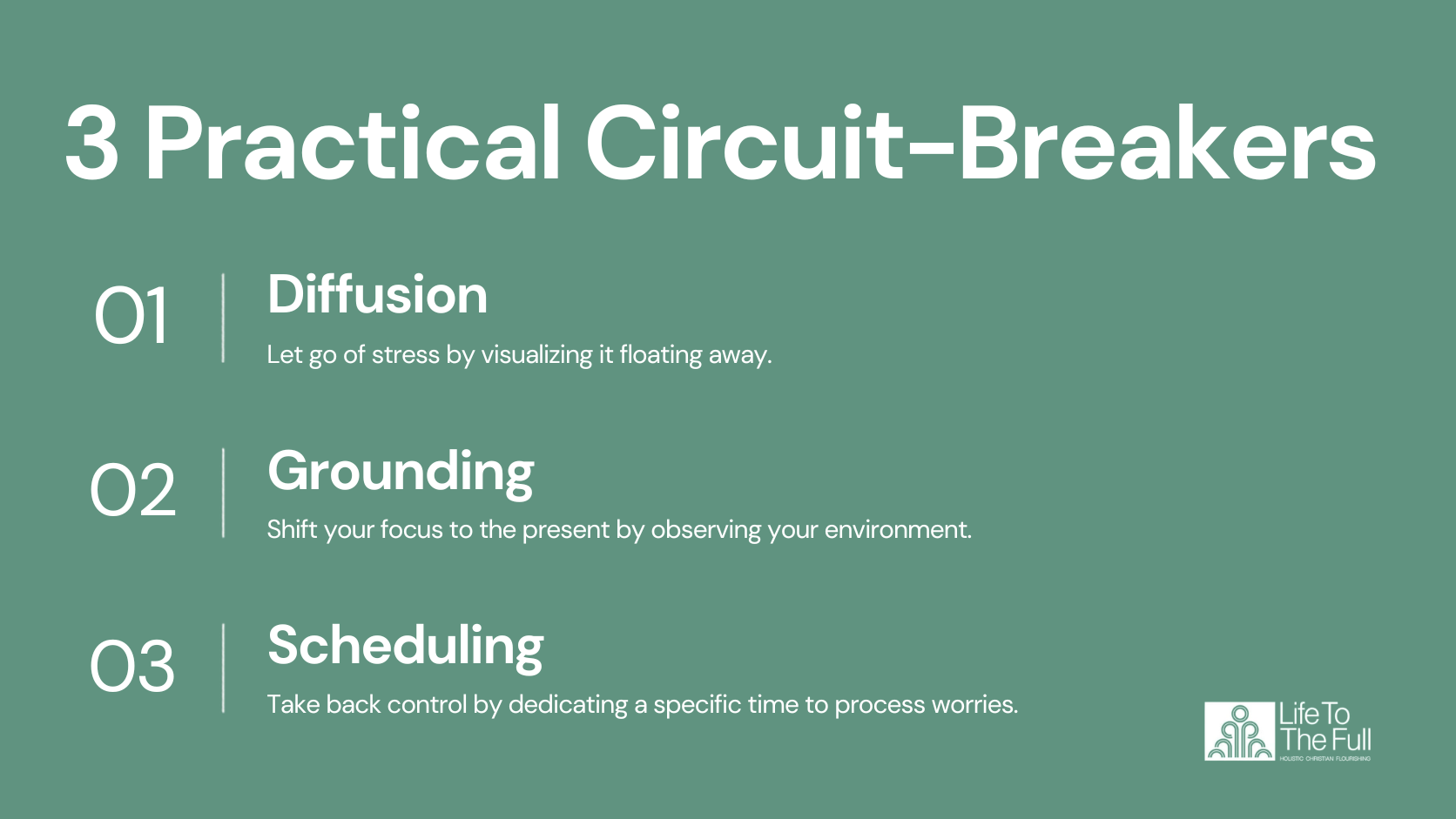
Using principles from Acceptance and Commitment Therapy (ACT), here are three immediate, actionable circuit-breakers:
The Diffusion Exercise (Letting Go): When a stressful thought hits, visualize it. Mentally place that specific stressor on a leaf, and picture that leaf gently floating away down a stream. This helps un-fuse your identity from anxiety.
Grounding in the Present (Shifting Focus): Anxiety lives in the future, so you must force your brain into the present. Look around your immediate environment and observe the simple things: notice the painting on the wall, the phone on your desk, or the sunset out your window. While it might feel overly simplistic at first, it interrupts the worry cycle and reminds your brain that it is possible to exist in the "now".
Scheduled Rumination (Taking Back Control): You cannot always permanently banish a worry, especially if it involves real-life responsibilities. Instead, schedule a specific time to worry. Dedicate a window like Thursday from 8:00 to 9:00 a.m. to intentionally map out pros and cons. This gives you the mastery to tell your brain at 1:00 a.m. on a Friday, "Not right now. I know I'm going to get to it on Thursday".
While these mental exercises are incredibly powerful for retraining your focus, you do not have to guide yourself through them alone.
Digital Lifelines: 4 Apps to Help Ground Your Mind
When your mind is racing, trying to invent your own grounding exercises can feel overwhelming. Using guided, meditative practices provides a structured way to begin the journey toward a present mind.
Here are four accessible apps you can keep in your pocket to interrupt an overthinking spiral:
Smiling Mind: A widely used mindfulness app that offers simple, guided exercises to help you observe what is happening in your body and your room.
Headspace: Excellent for beginners learning to build a daily habit of mindfulness and learning how to gently bring a distracted mind back to the present.
Calm: Focused on sleep and meditation, this app is highly effective for those 1:00 AM moments when your brain refuses to switch off.
Abide: A specifically Christian meditation app that pairs mental grounding techniques with scripture and spiritual comfort.
While these practical tools help calm the biology of our brains, many of us still wrestle with a heavier burden: the spiritual guilt of anxiety.
Grace for Your Mind: The Spiritual Side of Anxiety
For many Christians, an overactive mind comes with a heavy dose of shame. You might read biblical verses about having the "peace of God" and feel like your inability to turn off your anxious thoughts is a sign of spiritual failure.
If you are feeling this weight, it is vital to untangle your mental health from your spiritual worth. To help break down this shame, let's look at the contrast between the guilt we often feel and the grace God actually offers:
| The Weight We Carry (The Myth) | The Truth We Need (The Reality) |
|---|---|
| "My overthinking is a sign of weak faith." | Anxiety is heavily biological. It involves chemicals firing in the brain, and many people are naturally more susceptible to it from childhood. It is biology, not just theology. |
| "I am a terrible Christian for making bad habits." | Observe, don't condemn. Behavioral choices (like excessive screen time) can rewire our brains to over-function. Notice these habits curiously and adjust them to heal your brain, rather than shaming yourself. |
| "God is disappointed in my lack of peace." | God speaks with gentleness. In passages like Luke 7, even when addressing faith, Jesus immediately follows up by calling us His "tender sheep". |
| "Scripture commands are threats." | Scripture is an invitation to comfort. When Philippians 4 says "the Lord is near," it isn't a threat that He is watching your mistakes. He is saying, "My beloved child, it's going to be okay. I'm with you". |
Taking the Next Step Toward 'Life to the Full'
We often believe we should just be able to muscle through our mental health struggles through sheer willpower. But when your thoughts begin robbing you of the present moment leaving you physically present but entirely mentally absent from the joys of your everyday life something needs to change.
Reaching out for evidence-based therapy is a step rooted in compassion and hope. You are not weak for needing help; you simply have a need.
If you are hesitant to take that first step, try taking the DASS (Depression, Anxiety, and Stress Scale)questionnaire available on our website. Sometimes, seeing an objective score on a screen provides the validation you need to realize, "This is taking up more of my life than I want it to," and that it is finally time to get help.
You do not have to achieve a perfect, unbroken state of zen to be whole. Progress is the goal. And with the right strategies, you can learn to master your mind, defuse your worries, and step back into experiencing life to the full.